
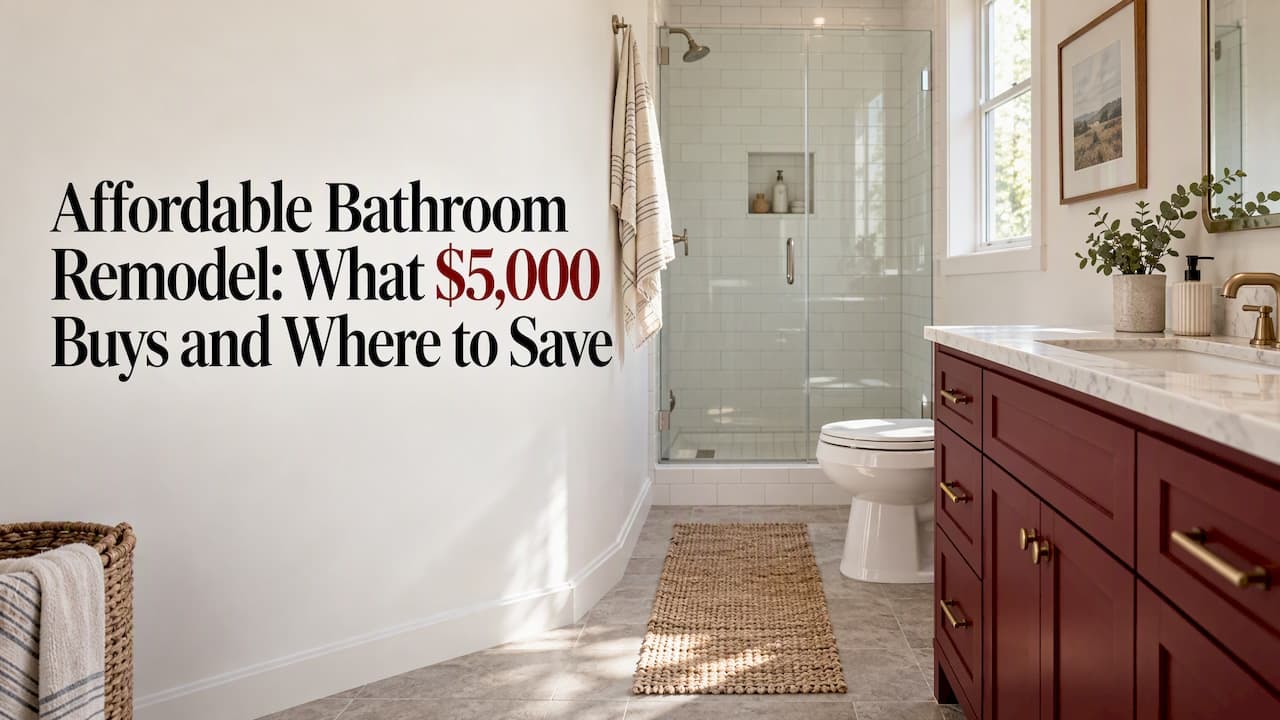
An affordable bathroom remodel is one that keeps the plumbing where it is, spends money on the surfaces you see and touch every day, and holds back a cushion for surprises. A limited refresh of a small bathroom can fit in about $5,000, and a cosmetic update can cost far less. A full gut with a new layout usually cannot. This guide shows what each budget level covers, where the money tends to disappear, what to do yourself, and how to buy a vanity and flooring without paying retail markup.
TL;DR
- Keep the layout. Moving a toilet by one foot can cost about $1,000, so same-footprint swaps are the biggest saver.
- Around $5,000 can cover a same-layout vanity, toilet, some flooring and a few fixtures in a small bathroom. Moving plumbing or electrical pushes the number up fast.
- Reserve 10% to 20% of the budget for hidden problems such as water damage, and never pay more than one-third upfront to a contractor.
- Buy the vanity, flooring and hardware factory-direct. Our vanities run from $384 to $1,535 depending on the line.
- A bid far below the others is a warning sign, not a bargain.
Table of Contents
- What "affordable" means for a bathroom
- The cheapest way to renovate a bathroom
- What $5,000 can realistically cover
- The most expensive part: moving things
- Where to spend and where to save
- Hidden costs and the contingency you need
- The 30% rule and your overall budget
- What to DIY and what to hire out
- How to hire without overpaying
- Planning for accessibility without overspending
- Our perspective
- Get the vanity, flooring and design help in one place
- A simple plan to follow
- FAQ
- Sources
What "affordable" means for a bathroom
There is no single price. Published estimates vary widely because they measure different jobs. Forbes Home reported an average bathroom remodel near $10,000 in 2022, a budget-friendly version as low as $2,500, and DIY material costs as low as $2,100. This Old House says a $5,000 limited refresh works particularly well in a small bathroom or when the work is cosmetic.
So start by deciding which of three jobs you are actually doing:
| Level | What it means | Where the money goes |
|---|---|---|
| Refresh | Paint, hardware, mirror, lighting, textiles, grout | Mostly materials, mostly DIY |
| Same-layout remodel | New vanity, toilet, flooring, fixtures, maybe a tub surround | Materials plus a plumber and installer |
| Layout change | Moved toilet, shower or tub, new electrical | Labor, permits, demolition |
The first two are where "affordable" lives. The third is a different budget category, and it is better to admit that early than to cut corners halfway through.
The cheapest way to renovate a bathroom
The cheapest renovation is the one that avoids demolition. Keep the flooring, vanity and shower or tub that still work, and change what people notice.
Better Homes & Gardens calls painting the easiest way to update a bathroom without a full remodel, and it points to low-cost changes such as new textiles and other surface finishes. A refresh like that typically includes:
- Paint in a moisture-rated finish
- New cabinet knobs, towel bars and a toilet paper holder
- A new mirror and light fixture
- A fresh shower curtain and rod
- Re-grouted tile or a simple backsplash accent
- Storage baskets, shelves and new towels
That is a weekend or two of work and a few hundred dollars. It will not fix a failing floor or a leaking tub, but it can make a tired room feel new.
What $5,000 can realistically cover
This is the question most readers actually have. Modernize states that about $5,000 may cover a same-layout vanity, toilet, some flooring and a few fixtures using mid-range materials. The same page says moving plumbing or electrical costs about $5,000 on its own for a new floor plan, and it lists permits, demolition, water damage and repairs as extra costs.
In practice, a $5,000 plan for a small bathroom (a typical hall or guest bath) might be split like this. These are planning proportions, not quotes:
- Vanity, top and faucet: the largest single material purchase for many small baths.
- Flooring: a waterproof plank or tile, which you can often install over a small footprint in a day or two.
- Toilet and basic fixtures: a standard replacement in the same spot.
- Paint, lighting and accessories: the cheap finishing layer that makes the rest look intentional.
- Contingency: the part people skip and later regret.
Forbes Home notes that fixtures and flooring each represent about 15% of a total remodel budget and painting about 5%, which gives you a useful sense of proportion when you build your own list.
If your bathroom is large, has a layout problem, or you want premium tile and a custom shower, $5,000 will not stretch. In that case, phase the work or use financing rather than trimming safety-related items. We cover that below.

The most expensive part: moving things
Moving plumbing fixtures is among the biggest costs in a bathroom. Consumer Reports says moving a toilet just one foot can cost $1,000. The reason is simple: walls and floors have to be opened, drain lines re-routed and everything closed up again, and each trade has to come back for its step.
Labor is the other big driver. Modernize reports that labor commonly represents 40% to 65% of a bathroom remodel. That is why keeping the layout and limiting how much contractor time you buy are the two central cost controls.
Two practical ways to stay in budget:
- Replace in place. Put the new toilet, vanity and tub exactly where the old ones were.
- Use small workarounds. Consumer Reports describes an offset flange, a roughly $10 part, that allows minor adjustments to a toilet's position without extensive plumbing work.
Where to spend and where to save
Not every dollar works equally hard. A useful rule: spend on what is hard to replace later and what you touch daily, and save on what is easy to swap.
Spend on waterproofing, ventilation and slip resistance
Water is what turns a cheap remodel into an expensive one. Good waterproofing behind tile and around the tub or shower, and a fan that actually vents moisture, protect everything else you buy.
For floors, Consumer Reports advises choosing tile with a coefficient of friction (COF) of 0.60 or higher for slip resistance. If you are shopping for something other than tile, ask for the product's wet-slip rating and pick a waterproof plank rather than anything that swells when wet. Our flooring collection includes waterproof SPC, WPC and vinyl options built for wet rooms.
Save on the vanity by buying factory-direct
The vanity is the center of a same-layout remodel, and it is where retail markup is easiest to avoid. We sell factory-direct vanities, so the price you see skips the traditional retail layers. The published ranges on our bathroom vanity page are:
| Vanity line | Published price range |
|---|---|
| 01-CX | $384 to $522 |
| 03-IMO | $387 to $690 |
| 02-IMO | $456 to $780 |
| 03-WH | $495 to $1,089 |
| 06-DOK | $545 to $1,535 |
The spread inside each line reflects size and configuration. A smaller single-sink vanity in the same footprint as your current one is almost always the cheapest route, and it avoids plumbing changes.
Save on hardware and finishing touches
New handles, a new faucet and a better mirror change the look of a room for very little. Our sinks and handles are sold the same way as the vanities, so you can match them to the cabinet in one order.
Do not save on electrical safety
Bathrooms mix water and power. The 2020 National Electrical Code requires GFCI protection for receptacles serving 250-volt appliances when they are in bathrooms or within 6 feet of sinks, bathtubs or showers. Whenever you add or change outlets or lighting circuits, have a licensed electrician do it and check what your local jurisdiction has adopted.
While the room is open, also check your water heater. Consumer Reports, citing the Consumer Product Safety Commission, recommends setting it to 120°F to prevent scalding. It costs nothing.
Hidden costs and the contingency you need
A cheap remodel becomes an expensive one when something unexpected is found behind the wall. This Old House lists water damage repairs, mold remediation and structural repairs among the usual surprises. It recommends at least 10% in contingency, while remodeler Jeff Sweenor suggests 15% to 20%. Modernize recommends reserving 15% for hidden costs.
On a $5,000 plan, 15% is $750. Treat it as spoken for. If you never need it, it becomes a nicer faucet or a mirror.
Other costs people forget:
- Permits, where your city requires them for plumbing or electrical changes
- Demolition and debris hauling
- Delivery of heavy items such as vanities and tops
- Caulk, sealant, shut-off valves, supply lines and other small parts
The 30% rule and your overall budget
You will see the 30% rule in remodeling discussions. As Fidelity describes it, it is a common guideline to spend no more than 30% of a home's value on renovations and projects, so that you stay financially comfortable and avoid over-improving the property. Fidelity also advises getting project estimates, separating fixed and variable costs, and saving for the unexpected.
For a single bathroom it is rarely the limiting factor. A $5,000 refresh is a small share of most homes' value. The rule matters more when a bathroom is one of several projects in the same year, such as a kitchen and flooring as well. Treat it as a ceiling for the whole plan, not a target.
What to DIY and what to hire out
DIY is the biggest legitimate saving on a small remodel, but only for the right tasks.
Reasonable for most careful homeowners:
- Painting and caulking
- Replacing knobs, towel bars, mirrors and light fixtures on existing wiring (with the power off at the breaker)
- Installing click-lock waterproof plank flooring in a simple rectangle
- Assembling and setting a ready-to-assemble vanity in the same location
Best left to licensed professionals:
- Moving or adding plumbing lines
- New electrical circuits
- Waterproofing a shower or tub surround
- Anything that requires a permit in your area
The NAHB states that more than 30% of the jobs professional remodelers perform come from failed DIY projects. It says DIY can be cost-effective for those with handyman skills, but that hiring a professional remodeler is the best way to ensure success. The sensible middle path is to do the finish work yourself and pay a pro for the parts that can leak or shock.
If you want help with the install side, we offer assembly and delivery as well as professional installation, and our general contractor page explains how we can coordinate the work. We do not publish prices for these services, so ask for a quote.
How to hire without overpaying
The lowest bid is not always the cheapest outcome. The NAHB and NARI warn that a bid significantly lower than the others is a red flag, often pointing to rushed work, low-quality materials or financial instability.
A few habits protect your budget:
- Get at least three written bids for the same scope, with materials itemized.
- Limit your deposit. The NAHB advises paying no more than one-third of project costs upfront and tying later payments to specific milestones.
- Write down every change. Delays and overruns are common, and remodeler Leo Lantz of the NAHB stresses that each setback should be communicated, explained and documented.
- Buy materials yourself when it makes sense. If you supply the vanity, flooring and hardware, you control quality and avoid contractor markup on materials. Confirm in writing who is responsible for any damage or defects.
Before you call anyone, do what remodelers recommend: collect inspiration, then write a prioritized list of needs and wants. That list is what keeps a bid comparable and a budget intact.
Planning for accessibility without overspending
If you or a family member may need an easier bathroom as you age, plan it into the remodel now, because adding it later costs more. Consumer Reports quotes Geoffrey Hoffman saying that advance planning, such as installing grab bars, helps people stay in their homes as they age. Blocking inside the wall during a remodel makes future grab bars easy to anchor.

The NAHB also notes that medically necessary changes, such as wider doorways or a roll-in shower, can be tax deductible when backed by a doctor's letter. Its explanation is a starting point; talk to a tax professional about your own situation.
Our perspective
We sell materials for a living, and the pattern we see is consistent: the remodels that stay affordable are the ones that decide on the layout first and buy materials second. People who start by browsing finishes tend to fall for a layout change, and that is where budgets break.
Our advice is to pick a vanity that fits the existing plumbing, choose waterproof flooring you can install in a day or two, and match the sink and handles in the same order so nothing arrives late. We offer free 3D kitchen and bath design, so you can see a layout before you spend on it. And because we work factory-direct, we are able to keep prices well below traditional retail, which we put at 30% to 60% in savings on our materials. For in-stock items, we aim to deliver within 24 to 48 hours, so a weekend project does not stall waiting on a box.
We would rather you spend $5,000 well than $9,000 on changes you did not need.
— Steve
Get the vanity, flooring and design help in one place
If you are planning a same-layout remodel, start with our bathroom vanities, then pair them with waterproof flooring and matching sinks and handles. We have completed over 12,000 kitchens and have 100+ positive Google reviews, and you can visit our showroom to see and sample materials in person.

If the project is bigger than a refresh, our financing support can help you spread the cost, and you can request a free quote with your measurements and a photo of the room.
A simple plan to follow
- Measure the room and photograph the plumbing and electrical locations.
- Decide: refresh, same-layout remodel or layout change. Be honest about which.
- Write a prioritized list of needs and wants.
- Set a total budget and subtract a 15% contingency.
- Price the vanity, flooring, toilet, fixtures and lighting.
- Decide what you will DIY and get written bids for the rest.
- Order materials early so they are on site before demolition starts.
- Keep a written record of every change and payment.
FAQ
What is the cheapest bathroom renovation?
A no-demolition refresh: new paint, hardware, mirror, lighting, textiles and fresh grout, with the existing vanity, floor and tub kept in place. It can often be done for a few hundred dollars in materials. Replacing fixtures in the same spot is the next cheapest step.
Can you redo a bathroom for $5,000?
Yes, in many small bathrooms. According to This Old House, a limited or cosmetic refresh fits that budget, usually covering paint, fixtures, lighting and minor improvements. A larger room, a layout change or premium materials usually will not fit.
What is the most expensive part of a bathroom remodel?
Moving plumbing. Consumer Reports notes that shifting a toilet one foot can cost $1,000, and Modernize says labor is commonly 40% to 65% of the total. Keeping fixtures where they are avoids most of that.
How much contingency should I plan for?
At least 10%, and many remodelers suggest 15% to 20%, because water damage or structural problems often appear once walls and floors are opened. On a $5,000 budget, hold back $500 to $1,000.
Sources
- Bathroom Remodel Cost in 2026, This Old House
- Bathroom Remodeling 101, This Old House
- 2026 Bathroom Remodel Cost Calculator, Modernize
- How Much Does a Bathroom Remodel Cost, Forbes Home
- How to Cut Bathroom Remodeling Costs, Consumer Reports
- Your Home Has Hidden Dangers, Consumer Reports
- 24 Low-Cost Bathroom Updates, Better Homes & Gardens
- Budgeting for home renovations, Fidelity
- Thinking About Home Remodeling? Start Here, NAHB
- NAHB and NARI guidance for working with remodelers
- 2020 National Electrical Code adoption kit, NAHB
- Design for Independent Living, NAHB