
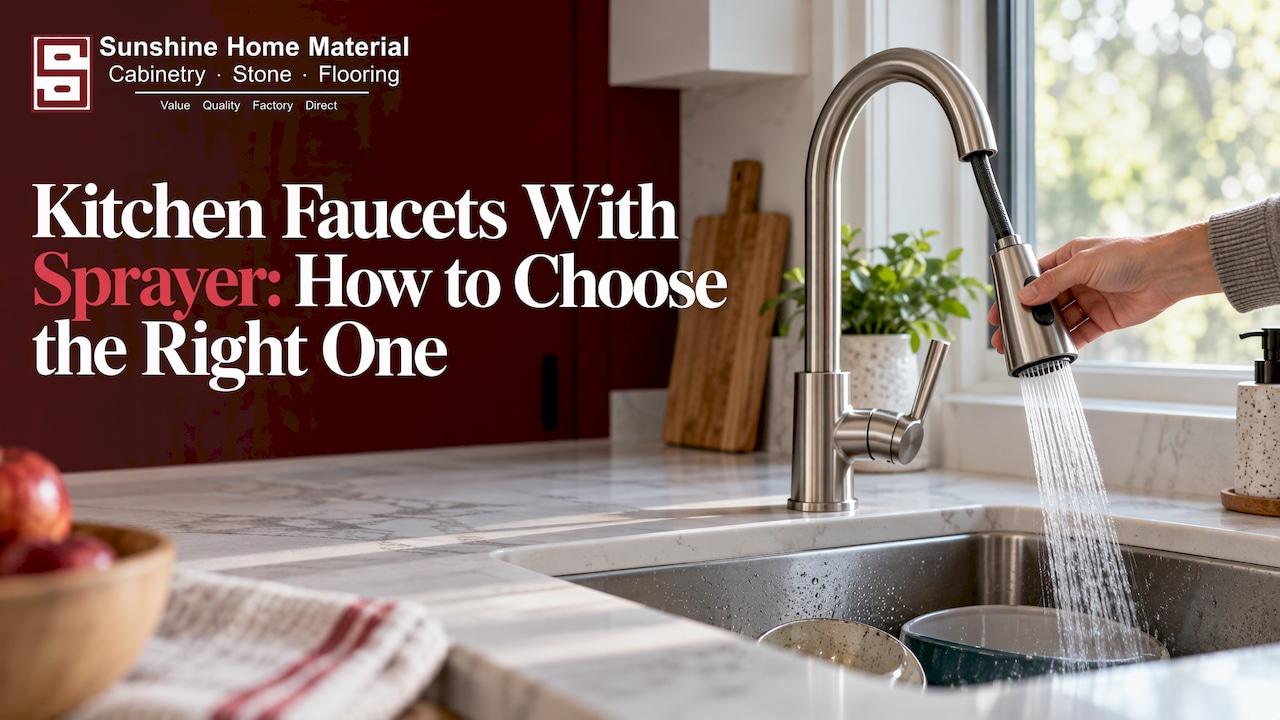
For most kitchens, a single-handle pull-down faucet is the easiest sprayer faucet to live with. It sits high, rinses big pots well and fits a one-hole sink. A pull-out suits low windows and shallow clearance. A side sprayer suits a sink that already has the extra hole. Whichever you pick, the sink decides what fits: hole count, reach and clearance matter more than the brand. We help Central Florida homeowners plan kitchens every day, so this guide walks through the choice in the order that saves you money and returns.
TL;DR
- Pull-down faucets are taller with a higher arc. Pull-out faucets are shorter, which helps under a window or cabinet.
- Side sprayers need an extra sink hole. A one-hole faucet with a cover plate can fill a multi-hole sink.
- Touchless and motion-sensor faucets can also have a retractable sprayer head.
- Federal rules cap kitchen faucet flow at 2.2 gpm at 60 psi. Some states set lower limits.
- Measure first: holes, reach to the drain, clearance behind the sink and countertop thickness.
Table of Contents
- The main types of kitchen faucets with a sprayer
- Quick comparison
- Check your sink before you pick a faucet
- Spray modes, finish and hose: what matters every day
- Flow rate rules for kitchen faucets in the U.S.
- Installing and maintaining a sprayer faucet
- Where the faucet fits in your kitchen plan
- Plan the sink, counter and hardware with us
- Our view: choose the faucet last, measure first
- FAQ
- Sources
The main types of kitchen faucets with a sprayer
There are four layouts you will see. Each handles the spray head differently.
Pull-down
The spray head sits on top of a tall spout and pulls downward toward the sink. Consumer Reports explains that pull-down and pull-out models both use a hose and counterweight to retract the head, and that a magnetic lock can hold the head in its dock. A BHG expert describes pull-down faucets as higher-arc designs, which is why they are the usual pick for deep sinks and tall stockpots.
Pull-out
The head pulls straight out toward you. Gerber's guide says pull-out faucets are generally shorter than pull-down models, which makes them a good fit when cabinets sit directly above the sink. Pull-down faucets are taller and give more clearance under the spray head for washing and rinsing. Pull-outs are typically low or no-arc designs, according to the same BHG expert.
Side sprayer
This is a separate spray head on its own hose, mounted in its own hole next to the faucet. It is common on older two-handle and three-hole setups. Gerber notes that extras such as a side sprayer, water dispenser or soap dispenser each need additional holes. If your sink has only one hole, a side sprayer is out unless you choose a different sink.
Touchless and motion-sensor
A sensor window detects a hand or object. A signal then opens a solenoid valve and the water runs. Bob Vila's testing covers touchless models with both pull-down and pull-out sprayers, and says most have a manual sensor-override mode. One model it describes starts by motion and also turns on when you remove the pull-down head, then shuts off when the head returns to its housing.

Sensor range varies by model. Pfister's documentation for its REACT line says the sensor activates when a hand or object is within 3 inches of it, and that its SmartStop feature shuts the faucet off after 3 minutes of inactivity. Check the sensor distance and the override option on any touchless model you consider.
Quick comparison
| Type | Best for | Watch for |
|---|---|---|
| Pull-down | Deep sinks, large pots, one-hole sinks | Needs vertical clearance under cabinets or windows |
| Pull-out | Low windows, shorter clearance | Lower arc means less room under the head |
| Side sprayer | Sinks with an extra hole | Needs one more hole and its own hose |
| Touchless | Messy hands, hands-free rinsing | Check sensor range and manual override |

Check your sink before you pick a faucet
This is where most returns start. Consumer Reports advises you to match the faucet's mounting holes to your sink, or use a base plate to cover extra holes. Do not buy a faucet that needs more holes than your sink has, and do not drill extra holes in an existing sink or countertop.
Count the holes
Gerber says an integrated single-handle faucet needs one hole, and a faucet with two separate handles usually needs three. KOHLER's buying guide says hole count in the counter or sink is the first factor to consider, and that escutcheon plates are often available so a single-hole faucet can work with a multi-hole sink. That makes a one-hole pull-down the most flexible choice for an existing sink.
Measure reach
Gerber defines reach as the horizontal distance from the center of the spout opening to the center of the spout base. It recommends measuring from the mounting holes to the center of the drain. The head should land water near the middle of the bowl. Also confirm that the pulled-out head reaches every corner of the sink, as Consumer Reports suggests.
Measure height and swing
Tall gooseneck spouts need room below a window sill or upper cabinet. A single handle needs room to rotate without hitting the backsplash or window ledge. The Residential Water Guide also notes that very thick stone or butcher-block countertops may need a longer mounting shank. One manufacturer's spec sheet lists a 3 1/2-inch maximum deck thickness, a good example of why you check the number on the box.
If you are choosing a new countertop at the same time, tell us the thickness and edge you are considering. A stone countertop changes the deck depth your faucet has to handle, and we can plan both together.
Check the sink itself
Sink style changes what works. An undermount sink has no deck, so the faucet mounts on the countertop, and the hole layout is cut during fabrication. Our guide to choosing undermount kitchen sinks covers what to decide before the countertop is cut, including how many faucet holes you need.
Spray modes, finish and hose: what matters every day
Spray and stream settings
At minimum, you want a stream for filling pots and a spray for rinsing. Bob Vila suggests also looking at pause, boost or sweep functions. Consumer Reports recommends a finger-friendly selector that switches between spray and stream and holds the chosen mode through on/off cycles until you change it. Try that selector in the store if you can. If the button is stiff or hard to find, you will notice it daily.
Body and hose
Spec sheets show what to look for. An American Standard Maven specification lists a pull-down spray, stream-to-spray adjustment, a pause function, a ceramic-disc cartridge, a metal body and braided supply hoses with 3/8-inch compression connections. The Kraus sheet lists a metal body, ABS sprayer, nylon waterway, 360-degree swivel and ceramic cartridge. Ceramic-disc cartridges and metal bodies show up again and again in these specs, so compare them across models.
Finish
Bob Vila lists chrome, stainless steel, brushed nickel and zinc alloy among common finishes, and notes that spot-resistant finishes show fewer fingerprints and smudges. In a busy kitchen, that matters. Match the finish to your cabinet hardware so the room looks planned. Our cabinet handles and accessories come in a range of finishes, which makes coordinating with the faucet easier.
Here is how to keep the finish looking new:
- Wipe the faucet dry after each use. California Faucets says this limits water spotting and mineral buildup on any finish.
- Use mild soap and water when it needs cleaning. Skip ammonia, bleach, abrasive chemicals and abrasive pads.
- For matte black and brushed nickel, use a soft microfiber cloth and water, and add a little dish soap for buildup, then rinse and dry, as this finish-care guide describes.
Splashes and cleaning water reach the floor too. If your remodel includes hardwood, see this guide to hardwood floor care after remodeling for how to clear dust and residue once the work is done.
Flow rate rules for kitchen faucets in the U.S.
Federal efficiency standards set a maximum of 2.2 gallons per minute at 60 psi for kitchen faucets, per the EPA WaterSense technical sheet. The same sheet says many models are available at 1.5 to 1.8 gpm for greater efficiency or to meet local requirements. It adds that a faucet may have a temporary boost mode but must return to its normal flow when turned off.
The federal rule traces to the Department of Energy's faucet standards, which cite 10 CFR 430.32(o). The Appliance Standards Awareness Project reports that the national standard took effect in 1994, and that as of 2024, 14 states had adopted stricter faucet standards. In the District of Columbia, for example, the rule is 1.8 gpm at 60 psi with an optional temporary 2.2 gpm, provided the faucet defaults back to 1.8 gpm after each use. A faucet rated at 1.8 gpm or lower is a safe pick wherever you live.

Installing and maintaining a sprayer faucet
Before you install
Before buying, check the supply lines and shutoff valves, and measure the space behind the sink and the cabinet space beneath it. Professional guidance from Clovis Plumbing Services says to verify hole count, hole spacing, sink and countertop material, clearance behind the sink, cabinet space below and existing supply connections before purchase.
One safety point: Kraus warns in its spec sheet that pull-out and pull-down faucets should not be connected to portable dishwashers, because pressure changes during wash cycles can rupture hoses or cause leaks.
If shutoffs are old or the space is tight, the Residential Water Guide advises having a licensed plumber do the install. We can refer you to independent installation professionals as part of your project.
Cleaning the aerator
Mineral deposits slow the flow. A maintenance guide recommends soaking a removable aerator in a 50/50 vinegar and water mix for several hours, rinsing it, and using a toothbrush on stubborn deposits.
Cleaning the sprayer head
The same guide gives these steps for the wand:
- Unscrew the wand from the hose.
- Flush the lines for two minutes.
- Tap the wand screen to knock out debris.
- Screw the wand back onto the hose.
Where the faucet fits in your kitchen plan
A faucet is one of the last things you choose, but it depends on early decisions. The sink bowl count, the countertop thickness and the backsplash height all set limits. Planning them in order avoids the common mistake of buying a faucet that does not fit the finished counter.
A workable order:
- Choose cabinets and the sink base size.
- Pick the countertop material and thickness.
- Choose the sink and decide how many faucet holes you need.
- Pick the faucet type from the table above.
- Match finishes across the faucet, handles and other hardware.
If you are working with a 3D kitchen design, you can see sink position, window height and cabinet clearance before anything is cut, which is exactly where a tall pull-down either fits or does not.
Plan the sink, counter and hardware with us
We are a family-owned kitchen and bath materials showroom in Orlando, serving homeowners, contractors, designers and investors across Central Florida. We carry sinks and handles, stone countertops, RTA cabinets and bathroom vanities, and we offer design consultations and referrals to independent installers. Bring your sink measurements and we will help you line up the countertop cut, sink and hardware so your faucet choice fits.

For sink and counter planning, start with our stone countertops. If you are remodeling the whole room, see our kitchen and bath remodels page. Doing the bathroom too? Our bathroom faucet replacement guide walks through that swap step by step.
Our view: choose the faucet last, measure first
Most faucet problems we hear about are not about the faucet. They are about a sink with the wrong number of holes, a window that sits too low, or a countertop thicker than the faucet shank.
That is why we plan the sink and countertop first. A one-hole pull-down is the flexible default for most new kitchens, since a cover plate can handle extra holes. If you want a side sprayer or soap dispenser, we plan for the extra holes before the countertop is cut.
We also see budgets go further when the whole room is planned together. Our factory-direct and wholesale-oriented pricing on cabinets, countertops, vanities and hardware is built for homeowners and contractors who want one place to coordinate materials, with free 3D design to check clearances first.
Bring your measurements to our showroom or start with a design consultation. We will help you get the sink, counter and hardware right the first time.
Sunshine Home Material
FAQ
What is the difference between a pull-down and a pull-out kitchen faucet?
Both use a hose and counterweight to retract the spray head. Pull-down faucets are taller with a higher arc, and the head pulls downward. Pull-out faucets are generally shorter and the head pulls toward you, which suits cabinets or windows close above the sink.
Can a touchless kitchen faucet have a sprayer?
Yes. Touchless models are available with pull-down and pull-out sprayers. Some turn on by motion and also when you pull the head from its housing, then shut off when it returns. Most have a manual override for the sensor.
Do I need a special sink for a faucet with a side sprayer?
You need an extra hole beyond the faucet's own. A single-handle faucet needs one hole, and a side sprayer, soap dispenser or water dispenser each need another. A one-hole sink cannot take a side sprayer. Do not drill additional holes in an existing sink or countertop.
What flow rate should a kitchen faucet have?
Federal standards cap kitchen faucets at 2.2 gpm at 60 psi. Many models run 1.5 to 1.8 gpm, and some states set stricter limits. Choosing a 1.8 gpm model meets the stricter rules in states that require it.
How do I clean a kitchen faucet sprayer head?
Unscrew the wand, flush the lines for two minutes, tap the screen to remove debris and screw it back on. For mineral buildup in a removable aerator, soak it in equal parts vinegar and water for several hours, then rinse.
Sources
- Best Faucet Buying Guide, Consumer Reports
- The 6 Best Kitchen Faucets, Tested by BHG
- Kitchen Faucet Guide, Gerber
- The Best Touchless Kitchen Faucets, Bob Vila
- Touchless Kitchen Faucets, Pfister REACT
- Kitchen Faucet Buying Guide, KOHLER
- Kitchen Faucet Buying Guide, Residential Water Guide
- Complete Faucet Buying Guide, Clovis Plumbing Services
- Maven specification, American Standard
- Kraus spec sheet
- Faucet Finish Care, California Faucets
- How to Clean Faucets, Chrome, Black and Nickel
- Faucet Care and Maintenance Guide
- WaterSense Labeled Homes Technical Sheet: Kitchen Faucets, EPA
- Faucets, U.S. Department of Energy
- Faucets, Appliance Standards Awareness Project
- Residential Kitchen and Lavatory Faucets, DC Department of Energy and Environment