
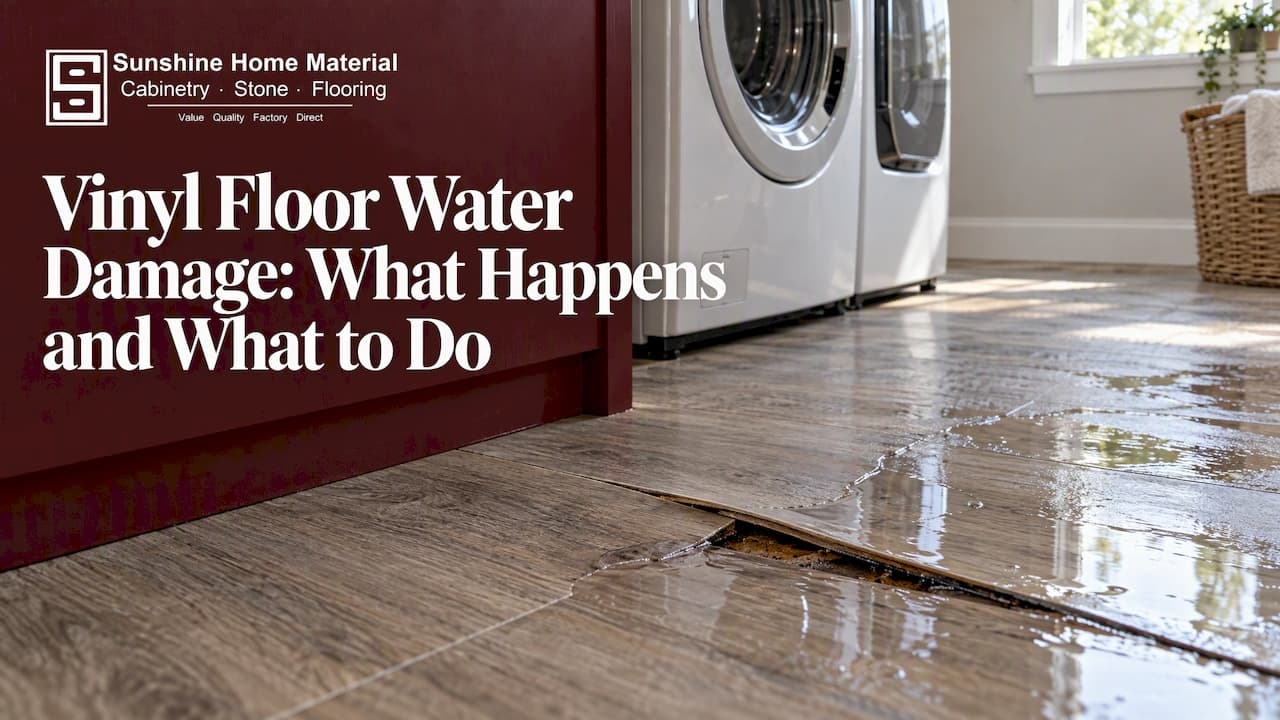
Vinyl is waterproof on top, but the floor underneath it is not. When water gets through a seam, past a dishwasher line or around a plumbing pipe, it can get trapped between the vinyl and the subfloor. Dry it fast, check the layer below, and most floors can be saved. Leave it for days and you may be replacing planks and subfloor.
This guide covers what water does under vinyl, how to spot it, what to do in the first 48 hours, when to call a professional, and how to choose and install vinyl so a kitchen leak stays a small problem.
TL;DR
- Vinyl planks and sheets don't absorb water, but water that gets beneath them can stay trapped against the subfloor.
- Aim to dry wet materials within 24 to 48 hours. EPA guidance says mold usually won't grow if they are dried in that window.
- A dry-looking surface proves nothing. Check the subfloor, and lift planks if you need to.
- Call a professional for anything bigger than a small spot, any water under the flooring, sewage, or an electrical hazard.
- In a kitchen, a continuous floor, sealed pipe openings and sealed baseboards do more than any product label.
Table of Contents
- What happens when water gets under vinyl flooring
- Signs your vinyl floor has water damage
- What to do in the first 48 hours
- Will it go away on its own?
- Can water-damaged vinyl be saved?
- When to call a professional
- Is waterproof vinyl a good choice for kitchens?
- How to keep water from getting under kitchen vinyl
- Our perspective
- Replacing a damaged floor without a long wait
- Checklist: before you replace or reinstall
- FAQ
- Sources
What happens when water gets under vinyl flooring
Vinyl is a vapor barrier. Once liquid migrates beneath it, evaporation is restricted and the water stays against the subfloor. The surface looks fine while the layer below stays wet.
That is why the person who says "it's vinyl, it can't be damaged" and the person with a swollen, smelly floor are often both right. The vinyl itself is fine. The materials around it are not.
The damage usually shows up in three places:
- The subfloor. Plywood or OSB can swell, soften and grow mold if it stays wet.
- The adhesive. On concrete, the slab itself doesn't mind moisture, but moisture can damage the adhesive holding vinyl tiles to it.
- Hidden layers. The EPA's moisture guidance notes that damage can occur out of sight beneath flooring, including adhesive failure and microbial growth. A dry surface does not mean a dry floor assembly.
Where the water usually comes from
In kitchens, the usual causes are a dishwasher or refrigerator line leak, a slow drip under the sink, an overflowing sink, and water tracked or splashed along the edges. In bathrooms and laundry rooms it's toilet seals, tubs and washing machines. Water rarely comes through the middle of a plank. It travels through seams, along walls, and down around pipe penetrations.

Signs your vinyl floor has water damage
Catch it early and you may only need to dry things out. Look for:
- Edges that lift, curl or no longer lie flat
- Planks that click apart or gaps opening at seams
- Soft or spongy spots when you walk
- Bubbles or raised areas in sheet vinyl
- A musty smell, especially after the room has been closed up
- Discoloration or dark spots at seams or along baseboards
- Cabinet toe-kicks or baseboards that swell or stain
A smell with no visible cause is a reason to investigate, not ignore. If the floor is a floating plank floor, you can often lift a few planks near the suspect area and look at the subfloor. On a glued floor, you'll need to look from the edges or from the room next door.
Is it really vinyl?
Before you plan anything, confirm what you have. Laminate has a fiberboard core that does swell with water, and it is often mistaken for vinyl. If your planks are puffing up at the edges, that points to laminate, and swollen laminate generally has to be replaced. If you're choosing between the two for a humid climate, our comparison of LVP and laminate for Florida homes explains the difference.
What to do in the first 48 hours
Speed is the whole game. The EPA recommends responding to clean-water damage within 24 to 48 hours. It is a guideline, not a cliff: mold will not always appear after 48 hours, but every extra day makes it more likely.
- Stop the source. Shut off the water supply to the appliance or fixture, or the main valve if you can't find it. If water is near outlets or appliances, turn off power to the area at the breaker first.
- Remove standing water. Mop, towel or use a wet vacuum. Move rugs, mats and furniture off the floor.
- Clean and dry the vinyl. For hard surfaces like vinyl, the EPA says to vacuum or damp-wipe with water and mild detergent, let it dry, and check that the underflooring is dry. If it is wet, dry it too.
- Open up the floor if water got under it. The Department of Energy's homeowner guidance says both glued and floating vinyl can trap water above the slab or subfloor, so lift it during drying when needed. Vinyl removed without damage may be reusable.
- Dry the layers below. Use dehumidifiers and air movement across the exposed subfloor. Wet insulation under the floor, if any, should come out so the framing and subfloor can dry thoroughly.
- Confirm it's dry before you cover it. Don't lay planks back down on a subfloor that still feels cool or damp. A moisture meter is cheap and removes the guesswork.
One caution on fans: if mold is already established, the CDC advises against using fans to dry because they can spread spores through the home. If you see or smell mold, stop and read the next sections.
Floating floor versus glued-down
A floating click-lock floor is easier to rescue. You can unclip planks back to the wet area, dry the subfloor, and reinstall the same planks if none are damaged. Glued-down vinyl is harder, and sheet vinyl is the hardest. Missouri's flood clean-up instructions say that when water gets under loose areas of sheet vinyl, the entire sheet should be removed. On a concrete subfloor, taking up tile or sheet vinyl also speeds drying.
Will it go away on its own?
No, not reliably. Water under vinyl has nowhere to go because the vinyl slows evaporation from above. A small amount, caught within a day, may leave nothing behind if you dry the area properly. But a floor that looks fine and is left alone can hide a wet subfloor for weeks.
How to tell if moisture remains:
- Press a moisture meter against the subfloor or slab after lifting a plank.
- Tape a small square of clear plastic to the exposed subfloor for a day. Condensation under it means moisture is still coming up.
- Notice smell. Musty air in a closed room is a warning sign.
- Check again after a few days. Cupping, soft spots or new gaps mean the problem is still active.
Can water-damaged vinyl be saved?
Often the vinyl can, and the subfloor decides the rest.
| Situation | Likely outcome |
|---|---|
| Surface spill, wiped within hours | Clean and dry, no further action |
| Water at a seam, caught within 24 to 48 hours | Lift nearby planks, dry the subfloor, reinstall undamaged planks |
| Water under glued vinyl or sheet vinyl | Remove the affected area or the full sheet, dry the base, replace |
| Soft or swollen subfloor | Cut out and replace the damaged subfloor before new flooring |
| Visible mold or a week or more of wet conditions | Professional assessment, likely removal and replacement |
If you have to replace, replace past the damaged area. Planks that look fine but sat in water can have compromised adhesive or locking edges. Match the planks to the room, too. If you can't find the original product, you may need to replace the whole run so the color and pattern match.
When to call a professional
Call a water-damage professional if the wet area is larger than a small spot or you find water under the flooring. Active flooding, sewage or any electrical hazard calls for an emergency response. For larger areas or deep intrusion, look for restoration companies certified by bodies such as the IICRC. The CDC's cleanup guide also recommends mold inspection or remediation professionals affiliated with or certified by such organizations.
Call an electrician before you touch anything if water reached outlets, the dishwasher's wiring or floor-level appliances. Call your insurer early too, since many policies require prompt notice and photos of the damage before cleanup.

Is waterproof vinyl a good choice for kitchens?
Yes, when it is installed well. The Building America Solution Center notes that properly installed vinyl can provide a waterproof barrier between a wet room and the subfloor. It also warns that peel-and-stick products may not hold up as well to repeated saturation.
That tells you what to look for when you shop:
- Rigid-core planks (SPC or WPC). These have a dense, dimensionally stable core designed for wet areas. Our XD800 SPC flooring and Platinum Turku WPC flooring are the type of product to compare for a kitchen.
- A wear layer thick enough for foot traffic. Kitchens take more abuse than bedrooms.
- Click-lock edges that fit tightly. Loose seams are where water gets in.
- Installation by someone who seals the edges. The best plank can't make up for an open perimeter.
For a broader walkthrough of core types, thickness and wear layers, see our vinyl flooring buying guide.
How to keep water from getting under kitchen vinyl
Most water damage is a detail problem, not a product problem. The same Building America guidance suggests:
- Run continuous water-resistant flooring wall to wall rather than stopping at cabinet edges.
- Carefully caulk and seal plumbing pipe penetrations.
- Use water-resistant baseboards sealed to the floor.
A few more habits help:
- Put a leak pan or water alarm under the dishwasher, sink and refrigerator ice-maker line.
- Replace old rubber supply hoses with braided lines.
- Wipe up spills and don't let pet bowls overflow at the seams.
- Skip harsh steam mops on seams.
- Don't let water sit at the dishwasher door edge.
One risk to know about if your home has a crawl space: vinyl is vapor-impermeable, and laid over vapor-permeable insulation it can create a double vapor barrier that traps moisture from a plumbing leak or overflow. Ask your installer how the floor assembly will handle moisture before you commit.
Our perspective
We sell a lot of vinyl and rigid-core flooring to Florida homeowners, and the same thing comes up again and again. People are told "waterproof" and assume nothing can go wrong. In our experience, what goes wrong is rarely the plank. It's a dishwasher hose, an open edge by the cabinets, or a floor installed over a subfloor that wasn't dry.
That's why we think the best protection is choosing the right product and installing it correctly. Our waterproof SPC and WPC lines are designed for kitchens and baths, and we're glad to talk through your layout, your subfloor and your budget before you order. Our free 3D design service lets you see the floor with your cabinets and countertops, so you plan the edges and transitions before anything is cut.
If you do have a leak, act quickly, dry the subfloor and replace what you must. A good floor is a smaller expense than a wet subfloor ignored for a month.
Sunshine Home Material
Replacing a damaged floor without a long wait
If your vinyl needs to come up, a delay matters, because the room can't be fully dry and finished until new flooring goes down. We sell factory-direct waterproof SPC and WPC flooring at wholesale-oriented prices, and in-stock materials can be delivered in 24 to 48 hours. You can also use our free 3D design service to plan the kitchen or bath with flooring, cabinets and countertops in one layout.

Browse our flooring collection or visit the Sunshine Home Material homepage to see cabinets, countertops, vanities and installation services. If you're remodeling in Central Florida, our Orlando kitchen and bath remodeling page shows how we can help with the whole project.
Checklist: before you replace or reinstall
- The water source is fixed and tested.
- The subfloor reads dry on a moisture meter in several spots.
- Any swollen or soft subfloor has been cut out and replaced.
- No musty smell remains with the room closed for a day.
- Pipe openings are sealed and baseboards are water-resistant.
- You have extra planks from the same lot for future repairs.
FAQ
What happens if vinyl flooring gets wet?
If the water stays on top and you wipe it up, nothing happens, because vinyl doesn't absorb water. If it gets through seams or edges, it can become trapped against the subfloor, where it can damage adhesive and let mold grow. Dry the area quickly and check the layer underneath.
Will water damage go away on its own?
Not reliably. Vinyl slows evaporation from above, so a wet subfloor can stay wet while the surface looks normal. The EPA says wet materials should be dried within 24 to 48 hours if possible, and in most cases mold will not grow if they are.
Can I use dish soap on vinyl plank flooring?
For cleaning up after a spill, the EPA's guidance for hard surfaces like vinyl is to damp-wipe with water and mild detergent. Use a small amount, wipe, and dry the floor. Avoid soaking the seams.
Are some laminates waterproof?
This depends on the product, so check the manufacturer's specifications. Standard laminate has a fiberboard core that swells when wet. For kitchens, we recommend a rigid-core vinyl such as SPC or WPC instead.
Is waterproof vinyl a good choice for a kitchen?
Yes, when it's properly installed. The Building America Solution Center says properly installed vinyl can form a waterproof barrier, as long as pipe openings are sealed and the floor runs continuously to sealed baseboards.
Sources
- Water Damaged Vinyl Flooring: Can It Be Saved?
- BSI-003: Concrete Floor Problems, Building Science Corporation
- Moisture Control Guidance for Building Design, Construction and Maintenance, EPA
- Mold Course Chapter 4, EPA
- Mold Remediation guidance table, EPA
- Repairing Walls & Floors: How To's for the Handy Homeowner, U.S. Department of Energy
- Flood Clean-Up Instructions, Missouri Department of Health
- Homeowner's and Renter's Guide to Mold Cleanup, CDC
- Water-Resistant Flooring, Building America Solution Center
- Floors above Crawl Spaces: Reducing the Risk of Moisture