
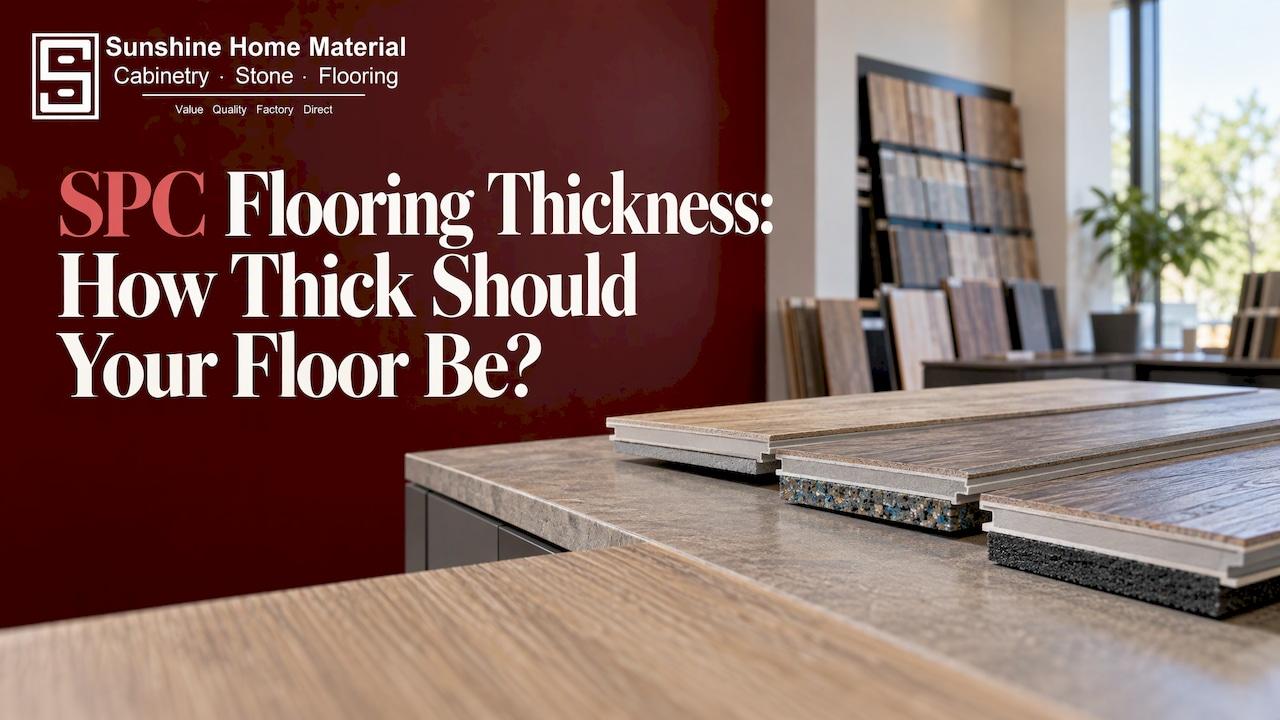
For most homes, a 5 mm to 6.5 mm SPC plank with a solid wear layer is the right pick. Go to 7 mm or 8 mm if your subfloor is less than perfect or you want a more solid feel underfoot. Total thickness matters, but it is only one number on the box. The wear layer, the core density and the condition of your subfloor decide how the floor performs.
This guide explains what SPC thickness measures, how it differs from the wear layer, which thickness suits each room, and what to check on the subfloor before you order.
TL;DR
- SPC thickness is the whole plank in millimeters. The wear layer is the clear top coating, measured separately in mils.
- Most residential rooms do well with 5 mm to 6.5 mm. Thicker planks help most on imperfect subfloors and in busy spaces.
- A thicker plank does not replace a good wear layer or a dense core. Check all three.
- Subfloor flatness matters more than a few extra millimeters: major makers call for about 3/16" in 10'.
- Our team can help you match thickness to your rooms and subfloor at our Orlando showroom.
Table of Contents
- What SPC flooring thickness actually measures
- Thickness vs. wear layer: which matters more
- Common SPC thickness ranges
- Best SPC thickness by room
- What thickness does for comfort, sound and stability
- The subfloor matters as much as the plank
- How to choose: a simple decision path
- Our perspective
- Browse SPC flooring in Orlando
- Common mistakes to avoid
- Budget tips for SPC flooring
- FAQ
- Sources
What SPC flooring thickness actually measures
SPC stands for stone plastic composite. It is a rigid vinyl plank with a dense core made mostly of limestone powder and PVC. When a box says "6 mm," that is the total plank thickness. It usually includes:
- the wear layer (the clear protective top coat)
- the printed decorative film that gives the look of wood or stone
- the rigid SPC core
- an attached backing pad, on some products
The core makes up most of that number. The wear layer is a tiny slice of it. That is why two planks with the same total thickness can wear very differently.
In the U.S., total thickness is usually listed in millimeters, while wear layer is listed in mils. One mil is one thousandth of an inch. Check the spec sheet to see whether the stated thickness includes an attached pad, because that changes how the floor feels and how much room your door clearances need.
Thickness vs. wear layer: which matters more
They do different jobs.
| Total plank thickness | Wear layer | |
|---|---|---|
| What it is | Whole plank, top to bottom | Clear top coating over the print |
| Unit | Millimeters (mm) | Mils |
| Main effect | Feel underfoot, stability, how well the plank bridges small subfloor flaws, sound | Resistance to scratches, scuffs and surface wear |
| Typical range you will see | About 4 mm to 8 mm | Often 12 mil to 30 mil |
If you are choosing between two floors, think of it this way:
- Wear layer protects the surface. Pets, kids, rolling chairs and gritty shoes wear the top coat first. A thin plank with a good wear layer will look better for longer than a thick plank with a thin one.
- Thickness supports the structure. It affects how the locking edges hold, how much a plank flexes over small dips and how solid it sounds when you walk.
- Core density matters too. A dense core in a thinner plank can outperform a lighter, foamier core in a thicker one. Ask for the core specs, not only the thickness.
If you want a refresher on how vinyl floors are built and priced, our vinyl flooring buying guide walks through the layers.
Common SPC thickness ranges
You will see SPC planks from roughly 4 mm up to 8 mm in most home-improvement catalogs. Here is how they usually compare in everyday use:
| Total thickness | Feel and stability | Best for |
|---|---|---|
| 4 mm | Slim, needs a flat subfloor | Renovations where height is tight, such as at door thresholds or over existing hard floors |
| 5 mm to 6.5 mm | Balanced, firm, cost-efficient | Most kitchens, baths, living rooms, bedrooms and hallways |
| 7 mm to 8 mm | Most solid, quieter underfoot | Large open areas, busy family rooms, and subfloors with minor imperfections |
Thicker is not automatically better. A recent piece from the INSTALL flooring installation association points out that many people assume 6 mm to 8 mm or more performs best everywhere, yet thinner 4 mm to 5 mm products can perform just as reliably when matched to the right conditions. The match is the point.
That means you should pick thickness based on the room and the subfloor, not just on the biggest number.

Best SPC thickness by room

Kitchens
Kitchens see dropped pans, dragged stools and constant foot traffic. A 5 mm to 6.5 mm plank works well here, paired with a strong wear layer. If your kitchen is open to a living area and you want one continuous floor, 6 mm and up gives a more solid feel across the larger run.
SPC has a rigid core that is not harmed by water, which suits kitchen spills. Still, wipe up standing water so it does not sit at seams and edges. Our post on what happens when vinyl floors get wet covers what to do if it does.
Bathrooms
Bathrooms are small, so total thickness is less about stability and more about height. A 4 mm to 6 mm plank is usually plenty. Thinner planks make it easier to keep transitions to hallway floors low. Seal around tubs, toilets and the perimeter as the manufacturer directs, and keep the expansion gap covered by trim.
If you are redoing the whole room, you can pair new flooring with one of our bathroom vanities so the finishes are planned together.
Living rooms and open-plan areas
Large rooms are where thicker planks pay off. A 6 mm to 8 mm plank feels more solid and can be a little quieter underfoot. Large areas also need more careful expansion planning (see the installation section below).
Bedrooms and hallways
Bedrooms see light traffic. A 5 mm to 6 mm plank is enough. Hallways take more foot traffic, so put your money into the wear layer rather than extra thickness.
Rentals and investment properties
If you manage rentals, you want something durable, quick to install and easy to replace by the plank. A 5 mm to 6.5 mm SPC with a strong wear layer is a practical standard for most units. Our LVP vs. laminate guide for Florida homes explains why vinyl-based floors suit the local climate.
What thickness does for comfort, sound and stability
- Comfort: SPC is firm by design. Extra thickness adds a little more cushion feel, especially if a pad is attached, but it will never feel like carpet.
- Sound: Thicker planks and attached pads generally reduce the hollow, clicky sound of a floating floor. If you are installing above living space in a two-story home, ask about the attached pad and check whether the manufacturer allows extra underlayment.
- Stability: A rigid core resists expansion and contraction, but it also relies on the locking system. That system works best on a flat base.
- Dents: Heavy furniture can leave marks on any vinyl. Felt pads under legs help on every thickness.
- Installation: Thicker, denser planks are heavier and harder to cut, but they can hide tiny subfloor irregularities better than very thin ones.
The subfloor matters as much as the plank
Thickness cannot rescue a bad subfloor. Installation guidelines from major SPC manufacturers treat flatness as a key requirement. COREtec's residential installation guidelines call for a subfloor that is clean, flat, dry and structurally sound, with flatness tolerances such as 3/16" in 10' or 1/8" in 6'. United Weavers' click-lock SPC instructions likewise call for dry, clean, flat, smooth substrates, within 3/16" (5 mm) over 10 ft, using cementitious leveling compound where needed.
Here is a practical pre-order checklist:
- Check flatness. Lay a straightedge or a 10-foot string across the floor and look for dips and humps beyond the tolerance. Grind high spots and fill low spots.
- Check moisture. Concrete slabs in Florida can carry moisture. Follow the plank maker's moisture testing rules. COREtec's brochure allows an extra 6 mil poly film (perm rating of 1 or less) as added moisture protection, per its installation guide.
- Use the right patch. The same guide states that cementitious patching and leveling compounds must meet moisture and pH requirements.
- Check the attached pad. If your plank already has a backing, confirm whether you may add underlayment, and keep within any thickness limits the maker sets. Stacking pads can weaken the locking system.
- Plan expansion gaps. United Weavers specifies 1/4" (6 mm) at walls, columns and jambs, with larger gaps for very large areas. Your plank's own instructions come first.
- Think about the space below. If you are finishing a lower-level space or garage area, a modular base such as basement flooring tiles can be part of preparing a dry, level surface before the planks go down.
When you are unsure, a thicker, denser plank gives you a little more tolerance. But the best fix is still a properly prepared floor.

How to choose: a simple decision path
- Measure your height limits. Check door clearances, appliance heights and transitions to other floors.
- Rate the subfloor. Flat and dry? A 5 mm to 6 mm plank is typically fine. Slightly imperfect or very large room? Move toward 6.5 mm to 8 mm after prep.
- Rate the traffic. Pets, kids, rentals and kitchens call for a stronger wear layer first, then thickness.
- Check the core. Ask about core density and the locking system.
- Match the pad. Decide whether you want an attached pad for sound and comfort, and make sure it is allowed.
- Ask for samples. Put them in the room, in your lighting, and walk on them.
Our perspective
We sell SPC flooring to Central Florida homeowners, contractors and property managers every week, and the same question comes up: "Should I just buy the thickest one?"
Our answer is to start with the room. In a typical Orlando kitchen or living area, a well-made 5 mm to 6.5 mm SPC plank with a good wear layer gives you the balance of cost, comfort and durability that most projects need. We steer people to thicker options when the room is large or the subfloor needs help, and to slimmer ones when height is tight.
We also tell customers to look past the single thickness number. Wear layer, core quality and the locking system all shape how the floor holds up in Florida's humid climate, and a flat subfloor protects the whole investment.
That is why we offer in-person sampling at our showroom, free design help and referrals to independent installation professionals. You can compare real planks side by side, talk through your subfloor and leave with a plan that fits your budget.
Sunshine Home Material
Browse SPC flooring in Orlando
If you are ready to compare real planks, visit our Orlando showroom or start online. We carry waterproof SPC and WPC flooring, including the Sunshine XD500 SPC flooring, the XD800 SPC flooring and the Platinum Turku WPC flooring. Our team offers design guidance, project estimates and material quotations, delivery and pickup options, and referrals to independent installers. Financing is available for qualified buyers.

See the full flooring collection or reach us through our main site to request a quote.
Common mistakes to avoid
- Buying on thickness alone. A thick plank with a weak wear layer or light core can wear and dent sooner than a slimmer, denser one.
- Skipping subfloor prep. Humps and dips stress the locking edges. Prep first.
- Stacking underlayment on a pre-padded plank. Many products already have a backing. Confirm what is allowed.
- Forgetting expansion gaps. Floating floors need space at walls and fixed objects, and trim should cover the gap, not pin the floor.
- Ignoring transitions. A 4 mm floor next to 8 mm of tile or a thicker plank in the next room creates a step. Measure and plan reducers.
- Not ordering overage. Order extra for cuts and future repairs, and keep the same lot for the whole room.
Budget tips for SPC flooring
Thickness changes price, but not always by much. Here is how to save without cutting corners:
- Use a mid-range thickness (5 mm to 6.5 mm) in bedrooms, hallways and baths, and save extra thickness for the largest or busiest area.
- Spend first on wear layer and core quality, not on the highest millimeter count.
- Prep the subfloor yourself where it is safe and simple, such as scraping, vacuuming and sweeping. Leave grinding, leveling and moisture issues to a qualified installer.
- Get a material quote for the full project, including trim, transitions and underlayment, so there are no surprises.
- Ask about financing if you want to floor the whole home at once.
FAQ
Is 6 mm SPC flooring thick enough?
Yes, for most homes. A 6 mm plank with a good wear layer handles kitchens, living rooms and bedrooms well when installed over a flat, dry subfloor. Step up to 7 mm or 8 mm for very large rooms or when you want a more solid feel.
Is thicker SPC flooring always better?
No. The INSTALL association notes that thinner 4 mm to 5 mm products can perform as reliably as thicker ones in the right conditions. Match thickness to the subfloor, the room and the traffic, and look at the wear layer and core as well.
What is the difference between SPC thickness and wear layer?
Thickness is the full plank in millimeters. The wear layer is the clear top coating over the printed film, measured in mils. Thickness affects feel and stability, while the wear layer protects the surface from scratches and scuffs.
Do I need underlayment under SPC flooring?
Only if the plank maker allows it. Many SPC products come with an attached pad, and adding another layer can void instructions or weaken the locks. Check the installation guide for the product you choose, and ask us if you are unsure.
What thickness is best for a bathroom?
A 4 mm to 6 mm plank is usually enough. Bathrooms are small, so keeping the floor height low at the door often matters more than extra stability. Seal the perimeter as the manufacturer directs.
Sources
- When Specifying SPC, Thicker Is Not Always Better (INSTALL)
- COREtec Pro SPC residential installation guidelines
- COREtec Pro SPC installation brochure
- United Weavers click-lock SPC installation instructions